MIG Welding Basics: How It Works, What You Need and How to Start
MIG welding feeds solid wire through a gun under shielding gas, and this guide covers how it works, the gear you need and starting settings.
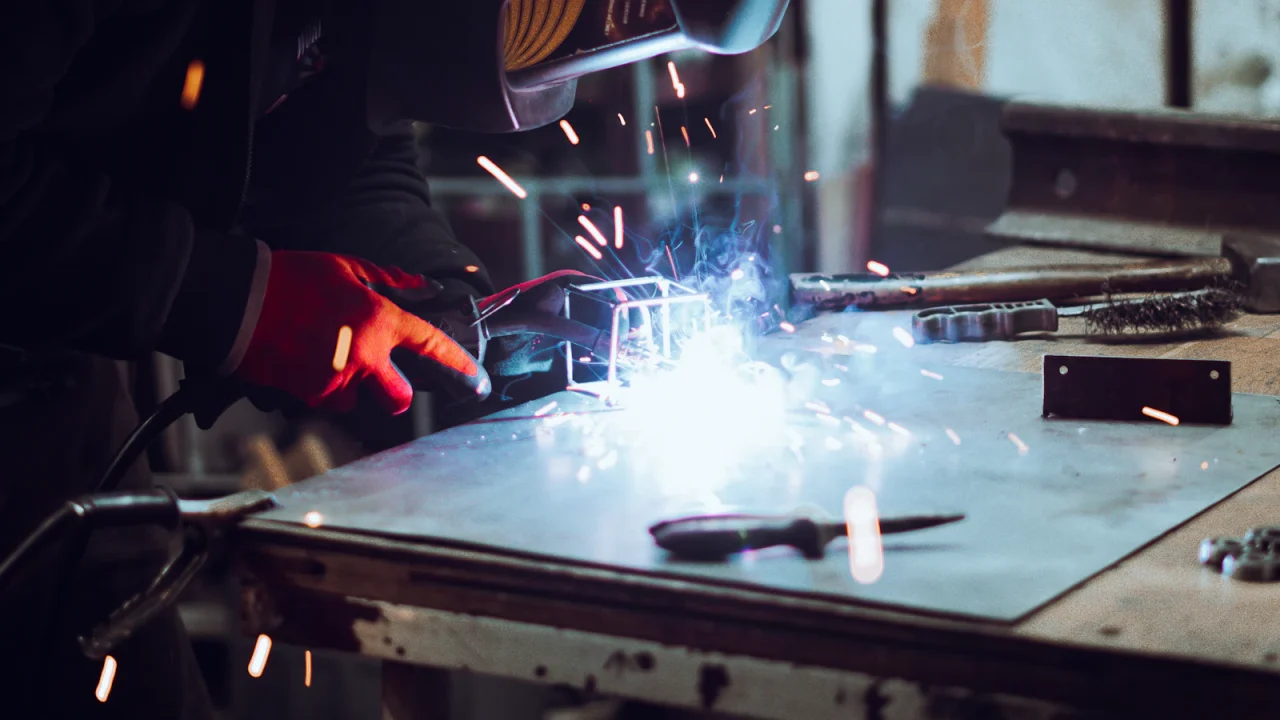
MIG welding feeds a thin solid wire through a gun while shielding gas flows around it. When you pull the trigger, the wire carries the arc and melts into the joint as filler, so one hand controls the whole weld. That is why it is the easiest arc process to pick up.
On this page
To start you need a wire-feed welder with a gas connection, a cylinder of shielding gas with a regulator, wire matched to your metal, protective gear and clean steel to practice on. For mild steel, the standard combination is ER70S-6 wire with a 75% argon / 25% CO2 gas mix.
How MIG welding works
A MIG welder is a constant-voltage power source with a motor that pushes wire from a spool, through a liner in the gun cable, and out of a copper contact tip. The tip transfers welding current to the wire. A clamp on the workpiece completes the circuit, and a nozzle around the tip directs shielding gas over the weld.
On small machines the usual mode is short-circuit transfer. The wire touches the puddle, shorts out, melts off and re-forms the arc many times each second, which gives the process its steady crackle. It puts in relatively little heat, so it suits thin and moderate material and works in any position.
Two controls do most of the work. Wire feed speed sets the amperage: more wire per minute means more current and more heat. Voltage sets the arc length and how wide and flat the bead lies. The two have to be balanced against each other for the wire diameter and metal thickness.
What you need to get started
- A gas-capable wire-feed welder. Flux-core-only machines cannot run solid wire with gas. The guide to choosing a beginner welder covers power and size.
- Shielding gas, regulator and hose. See the MIG gas guide for mixes and flow.
- Wire matched to the base metal, plus drive rolls and contact tips of the same diameter.
- Protective gear: helmet, safety glasses, gloves, jacket and boots, as listed in the welding PPE checklist.
- Prep and holding tools: an angle grinder with flap discs, a wire brush, clamps, and welding pliers for trimming wire and cleaning the nozzle.
- A suitable circuit. Have a qualified electrician install any new outlet.
Choosing wire and gas for mild steel
ER70S-6 is the general-purpose mild steel wire. It contains deoxidizers that help it cope with light mill scale, although clean metal still welds better. Choose the diameter by the thickness you weld most often:
- .023 or .025 inch: thin sheet metal, where low heat matters.
- .030 inch: the all-round size for small machines.
- .035 inch: thicker steel, if your machine has the output to run it.
For gas, 75% argon / 25% CO2 gives a stable arc, low spatter and a good bead shape across that range. Straight CO2 costs less and penetrates deeper, with more spatter and a rougher bead. Stainless and aluminum need different wire and gas, and aluminum usually needs a spool gun.
Setting up the machine
- Fit the spool so it unwinds without overrunning, and feed the wire through drive rolls that match its diameter and type.
- Set drive roll tension just tight enough to feed without slipping. Too much crushes the wire and causes tangles at the rolls.
- Install a contact tip of the same diameter as the wire.
- Check polarity. Solid wire with gas runs on DC electrode positive.
- Secure the cylinder upright, connect the regulator, and set the flow in the common starting range of roughly 20 to 30 cubic feet per hour indoors.
- Clamp the work lead to clean, bare metal on the workpiece.
- Set voltage and wire speed from the chart inside the machine for your wire diameter and metal thickness.
A rough cross-check on steel is about 1 amp for every .001 inch of thickness, so 1/8-inch material calls for around 125 amps. These are starting points only. Confirm them against your machine’s chart and manual, then test on scrap of the same thickness.
Running your first beads
Grind a piece of flat mild steel to bright metal and practice straight beads before attempting joints. Hold the gun so about 3/8 inch of wire extends past the contact tip, and tilt it 5 to 15 degrees from vertical along the line of travel. You can push, with the wire pointing ahead at unwelded metal, or pull, with the wire pointing back at the bead. Pushing gives a flatter bead and a better view, while pulling penetrates a little deeper.
Move at a speed that keeps the arc on the leading edge of the puddle. A good bead is even in width, slightly crowned and blended into the plate at both edges. A tall, narrow bead means too little heat or too much speed. A wide, sunken bead or a hole means the opposite.
Once flat beads are consistent, move on to lap joints and T-joints, then butt joints. Simple beginner welding projects give that practice a purpose.
First-week problems and what they mean
- Pinholes in the bead: shielding gas is not reaching the puddle, or the metal is contaminated. See weld porosity causes and fixes.
- Heavy spatter: voltage and wire speed are out of balance, stickout is too long, or polarity is wrong. See MIG spatter causes and fixes.
- Wire tangling at the drive rolls: too much roll tension, a clogged or wrong-size tip, or a kinked liner.
- Wire burning back to the tip: wire speed too low for the voltage, or the gun held too close.
- Burn-through: too much heat or too slow a travel speed for the thickness.
The common beginner welding mistakes guide goes through technique errors in more detail.
Frequently asked questions
Can you MIG weld without gas?
How thick can a MIG welder weld?
Can I weld aluminum with a MIG welder?
Do I still need to clean the metal if the wire has deoxidizers?
Sources and further reading
Keep reading
Related guides
Guide
MIG Welding Gas: What to Use for Steel, Stainless and Aluminum
For MIG welding, use 75/25 argon/CO2 on mild steel, 100% argon on aluminum, and tri-mix or 98/2 argon/CO2 on stainless steel.
Material guide
How to Weld Aluminum: Processes, Prep and Common Problems
Aluminum needs AC TIG or MIG with a spool gun, pure argon and careful cleaning. This guide covers prep, filler choice, technique…
Buying advice
What Welder Should a Beginner Buy?
A beginner should usually buy a wire-feed welder: 120V flux-core for a low-cost start, or a gas-capable MIG machine for cleaner welds…