How to Set Up a Safe Home Welding Area
A safe home welding area needs bare concrete, combustibles moved 35 feet away or shielded, ventilation, a suitable circuit and a fire extinguisher.
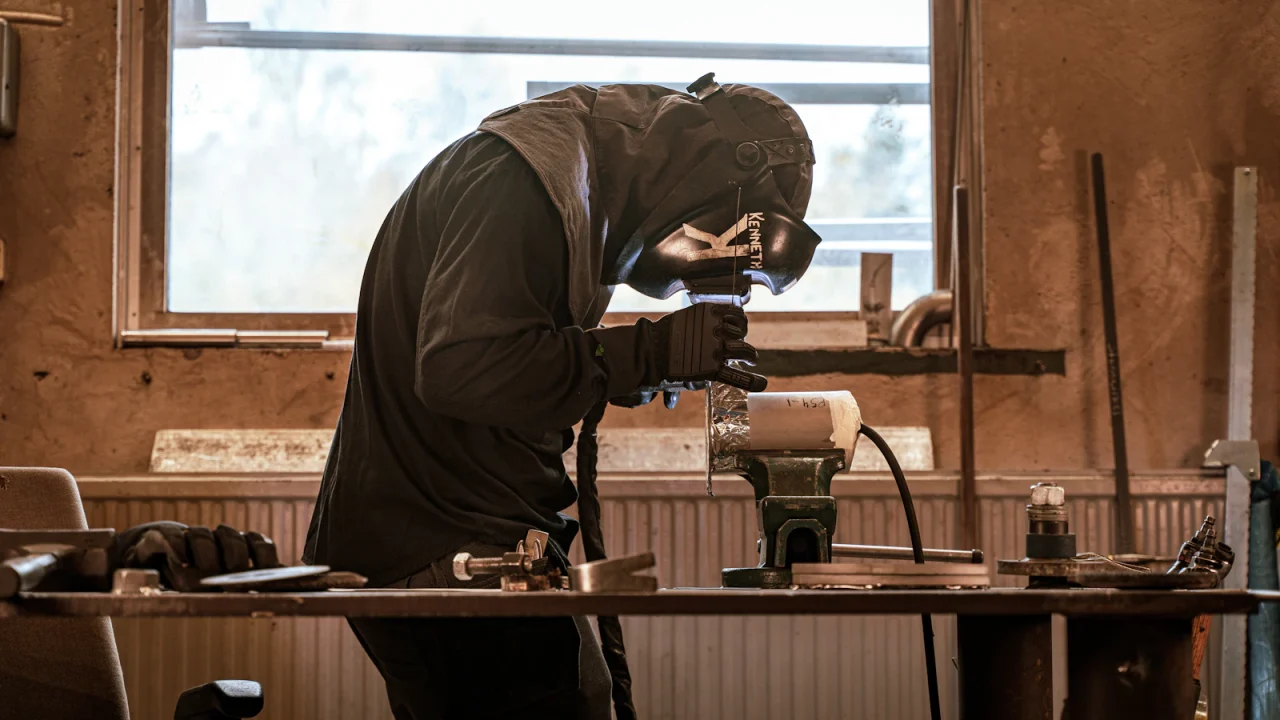
A safe home welding area has a bare concrete floor, nothing flammable within 35 feet of the arc unless it is shielded, air moving across the work, a circuit that matches the welder’s requirements, cylinders chained upright, and a fire extinguisher within reach. A cleared section of a garage or a driveway pad can meet all of that. A garage with a parked car, a gas can, and a stack of cardboard can’t until you change it.
On this page
This is general guidance. Your local fire and electrical codes, the machine’s manual, and your home insurance conditions come first.
Choose the spot: garage or driveway
Both work. The garage gives you power, shelter, and privacy, but it concentrates fume and is usually full of things that burn. The driveway gives you distance and fresh air, but adds wind and an audience, and you can’t weld there in rain or on wet ground.
| Factor | Garage | Driveway |
|---|---|---|
| Ventilation | Needs open doors and moving air | Naturally good |
| Things that burn | Usually many: vehicles, fuel, paint, cardboard | Usually few; watch for dry grass and leaves |
| Wind | Still air suits gas-shielded MIG and TIG | Wind strips shielding gas; flux-core and stick cope better |
| Bystanders | Arc is easy to screen | Arc is visible from the street |
Lay out either space the same way. Put the table in the middle of the cleared zone, and aim welding and grinding sparks away from doors, vehicles, and cylinders. Never set up with the work between you and the only way out. If you plan to weld outside regularly, MIG vs. flux-core explains which process tolerates wind.
Floor, table, and work surfaces
Bare concrete is the right floor. Sweep it before every session, because sawdust, leaves, and dry debris are what sparks find first. Wipe up oil and fuel drips, and cover floor drains, expansion joints, and gaps under doors where sparks can roll out of sight.
Remove rubber mats and rugs, which can melt or burn, and keep the work up off the floor on a steel table. A wooden bench is not a welding surface, even with a sheet of steel laid on top, because heat conducts through the sheet and sparks collect underneath. You can build a welding table as an early project.
The 35-foot rule: clear or shield combustibles
OSHA’s welding standard says that, where practicable, combustibles should be relocated at least 35 feet from the work, and NFPA guidance uses the same radius. NFPA’s hot work fact sheet attributes an average of 4,580 structure fires a year to hot work in 2014 to 2018, and 43 percent of them were in or on homes.
In a typical garage, the list of things to move includes:
- Gasoline cans, propane cylinders, and anything with a fuel tank, such as mowers, motorcycles, and cars
- Paint, solvents, aerosol cans, and oily rags
- Cardboard, paper, sawdust, and stored fabric or furniture
Few home garages are 35 feet clear in every direction, so shielding does the rest. Cover what can’t be moved with flame-resistant welding blankets, or stand sheet metal or welding screens between it and the arc. Pay attention to exposed wall framing, paper-faced insulation, and openings into wall cavities. If something flammable can be neither moved nor shielded, the standard’s answer is plain: don’t weld there.
Ventilation
Fume control at home means moving fresh air through the space and keeping your face out of the rising plume. Open the main door and a second opening if you have one, and set a fan to push air across the work area and out, not straight at the weld. A strong draft at the arc blows away shielding gas and causes porosity.
That is reasonable for short sessions on clean mild steel. Galvanized, stainless, painted, or plated metal calls for local fume extraction at the arc, a suitable respirator, or both. Never weld in a pit, crawl space, or small closed room, where shielding gas can displace the air you breathe. Welding safety basics goes through the fume hazards by material.
Power supply
Read the welder’s nameplate and manual before you plug it in. They state the input voltage, the current the machine draws, and the circuit it needs. As a general pattern, many 120V welders call for a dedicated 20-amp circuit, and 240V machines commonly use 30- to 50-amp circuits with a matching receptacle. The actual requirement is whatever the manual says.
Any new circuit, receptacle, or breaker change is a job for a qualified electrician. Don’t fit a larger breaker to stop nuisance trips, and don’t use an adapter to make a plug fit a different receptacle. Avoid long or light-duty extension cords, which cause voltage drop and overheating. 120V vs 240V welders explains the trade-offs.
Cylinder storage
Shielding gas cylinders stay upright and chained, either to a welding cart built to carry one or to a wall bracket. Fit the valve cap whenever the regulator is off or the cylinder is being moved, and close the valve at the end of every session. Store cylinders in a dry, well-ventilated spot away from sparks, hot metal, and heaters, and never in a closet or a closed vehicle.
Fire readiness and bystanders
Extinguisher and fire watch
Keep a fire extinguisher within reach of where you stand, on the exit side of the work. A multipurpose dry chemical (ABC) extinguisher is the usual choice for a home shop because it is rated for ordinary combustibles, flammable liquids, and energized electrical equipment.
Then keep a fire watch. Stay in the area after your last weld or grind, and check behind, under, and beside everything sparks could have reached. OSHA’s welding standard requires at least half an hour. NFPA’s hot work fact sheet, based on the 2019 edition of NFPA 51B, says a minimum of 60 minutes. Finish welding well before you plan to leave or go to bed.
Bystanders, pets, and UV screens
The arc can burn the eyes of anyone who looks at it, including a child in the doorway or a neighbor across the driveway. Put flame-resistant welding screens or curtains across any line of sight, and warn people before you strike. Keep children and pets out entirely. Your own protection is covered in the PPE checklist.
Frequently asked questions
Can I weld in an attached garage?
Can I plug a welder into a regular garage outlet?
Can I weld in a basement or a garden shed?
Sources and further reading
Keep reading
Related guides
Safety
Welding Safety Basics: The Real Hazards and How to Control Them
Welding has six real hazards (arc rays, fire, fumes, electric shock, gas cylinders and grinding), and each one has specific controls that…
Guide
Welding Helmet Shade Guide: Which Lens Shade Do You Need?
Most home MIG, stick and TIG welding needs a shade 10 to 12 lens; this chart gives OSHA minimum and comfort shades…
Safety
Welding PPE Checklist: What to Wear Before You Strike an Arc
Before you weld, put on a helmet, safety glasses, a flame-resistant jacket, leather gloves, cuffless pants over leather boots and hearing protection.