Buying guide
MIG Welder Buying Guide: How to Choose the Right Machine
How to choose a MIG welder: input voltage, amperage range, duty cycle, drive system and the gas kit to budget for, in plain terms.
WelderGuru is reader-supported. As an Amazon Associate we earn from qualifying purchases made through links on this page, at no extra cost to you. Learn more.
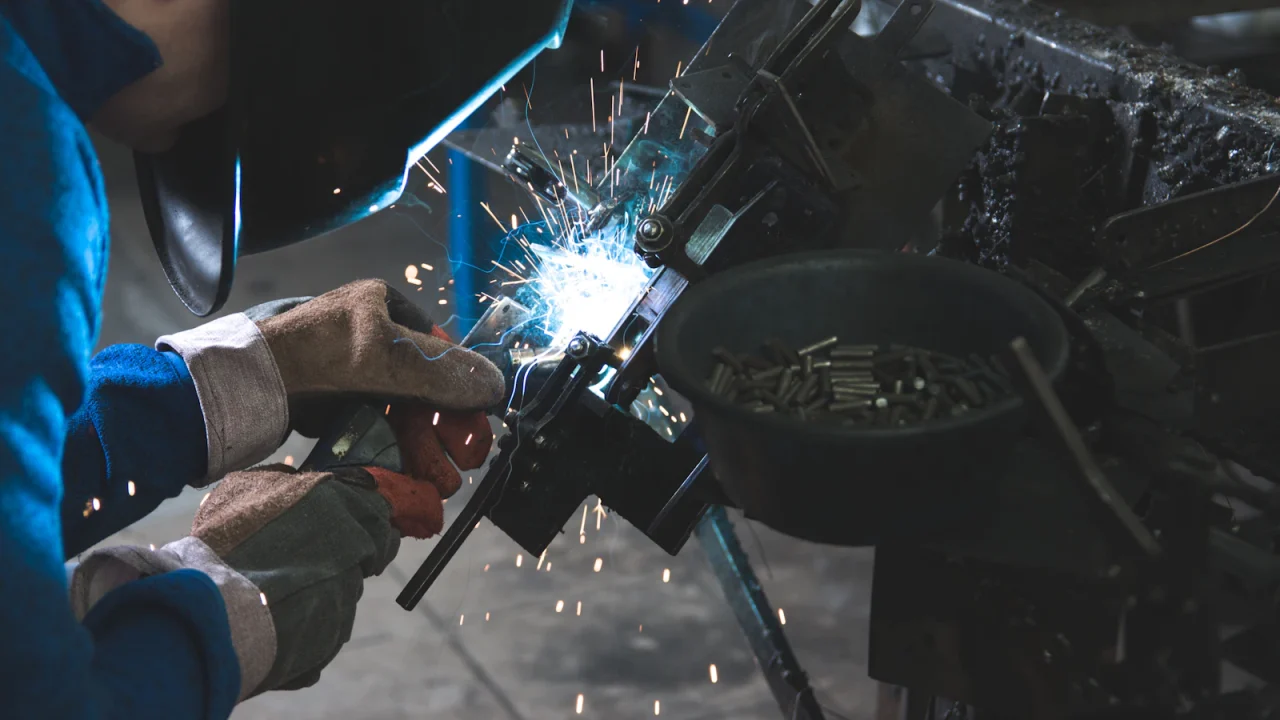
A MIG welder suits the home fabricator who works mostly indoors on mild steel, from sheet metal up to plate around 1/4 inch, and wants clean welds with little cleanup. It feeds solid wire through a gun while shielding gas protects the puddle, which makes it the easiest clean process to learn.
On this page
The decision that matters most is input voltage. A 120V machine covers thin sheet up to roughly 3/16-inch steel in a single pass. A 240V or dual-voltage machine is the practical route to 1/4 inch and beyond. Settle that before you compare anything else.
Who a MIG welder suits, and who should look elsewhere
MIG fits garage projects in mild steel: carts, tables, brackets and sheet metal repair. The wire feeds continuously, so you can concentrate on gun angle and travel speed. MIG welding basics covers the technique.
Look elsewhere if most of your welding happens outdoors, because wind strips the shielding gas away and leaves porous welds. A flux-core welder or stick welder handles that better, and the same applies if you cannot store a gas cylinder. For precise work on thin stainless or aluminum, compare a TIG welder.
MIG welder types compared
| Type | Best for | Process | Power | Key feature | Check price |
|---|---|---|---|---|---|
| 120V MIG | Sheet metal and light garage projects | MIG and flux-core | 120V; many call for a dedicated 20 A circuit | Typically tops out around 140 A, roughly 3/16 inch in one pass | See on Amazon (opens Amazon in a new tab) |
| Dual-voltage MIG | A first machine with room to grow | MIG and flux-core, often spool-gun ready | 120V or 240V, with reduced output on 120V | Starts on a household outlet and moves to 240V later | See on Amazon (opens Amazon in a new tab) |
| 240V MIG | Regular work on 1/4 inch and thicker steel | MIG and flux-core | 240V; commonly 30 to 50 A circuits, per the nameplate | 180 to 250 A for roughly 5/16 to 1/2 inch, with a longer duty cycle | See on Amazon (opens Amazon in a new tab) |
| MIG with spool gun | Occasional aluminum | MIG with 100% argon | 240V preferred | Spool gun feeds soft aluminum wire over a short distance | See on Amazon (opens Amazon in a new tab) |
| Multi-process with MIG | Trying stick and TIG alongside MIG | MIG, flux-core, stick and usually lift TIG | Usually dual-voltage | One power source; the TIG side is often DC only | See on Amazon (opens Amazon in a new tab) |
These figures are typical for each type. Confirm rated output and the capacity chart on the product listing and in the manual. The 120V vs 240V comparison goes deeper on voltage.
Specifications that matter on a MIG welder
- Amperage range. Using 1 amp per .001 inch, 1/8-inch steel needs about 125 A. Above about 3/16 inch, rely on the manufacturer’s capacity chart. A low minimum output matters for thin sheet.
- Duty cycle. A percentage of 10 minutes at a stated amperage: 30% at 90 A means 3 minutes of welding and 7 minutes of cooling. Compare machines at the same amperage; the duty cycle calculator turns a rating into minutes.
- Drive system. A cast-metal drive assembly with adjustable tension feeds more consistently than a light plastic one. Check the included drive rolls: V-groove for solid wire, knurled for flux-core.
- Wire and spool capacity. Confirm the machine feeds .023 or .025-inch wire for sheet and .030 to .035-inch wire for general work, and whether it takes 8-inch spools as well as 4-inch.
- Voltage control. Tapped machines offer a few fixed voltage steps, while infinite adjustment lets you fine-tune.
- Gas hardware and gun. Look for a gas inlet and solenoid, check whether a regulator is included, and confirm the gun takes widely available tips and nozzles.
- Warranty and support. Compare warranty length and US parts and service.
Best for beginners
Dual-voltage MIG welder
Why consider it
- Runs on a 120V outlet now and delivers more output on 240V later
- Feeds solid wire with gas indoors and self-shielded flux-core wire outdoors
- Many models accept a spool gun for aluminum; confirm on the listing
Best for: A first machine for garage projects on thin to moderate steel, with a path to thicker work
Check price on Amazon (opens Amazon in a new tab)
Type-level recommendation. Compare current models, specifications and prices on Amazon. We may earn a commission.
Best for a household outlet
120V MIG welder
Why consider it
- Typically reaches about 140 A, enough for roughly 3/16-inch steel in one pass
- Compact and light enough to move around a garage
- Many call for a dedicated 20 A circuit; check the manual
Best for: Sheet metal, light tubing and small projects where 240V is not available
Check price on Amazon (opens Amazon in a new tab)
Type-level recommendation. Compare current models, specifications and prices on Amazon. We may earn a commission.
Best for thicker steel
240V MIG welder
Why consider it
- Typical output of 180 to 250 A covers roughly 5/16 to 1/2-inch steel
- Higher duty cycle at mid-range amperage for longer welds
- Needs a 240V outlet on a circuit that matches the nameplate
Best for: Regular fabrication in 1/4-inch and thicker mild steel
Check price on Amazon (opens Amazon in a new tab)
Type-level recommendation. Compare current models, specifications and prices on Amazon. We may earn a commission.
Other kit and running costs
A MIG machine needs a cylinder of shielding gas before it welds. For mild steel that is 75/25 argon/CO2, and the MIG welding gas guide explains the options. Cylinders are bought or leased from a local gas supplier and exchanged when empty.
Ongoing costs are gas refills, wire, contact tips, nozzles and the occasional liner. Add a helmet, gloves, a jacket, an angle grinder and clamps if you do not own them, plus a welding cart that holds the cylinder upright and secured.
Common buying mistakes
- Buying a gasless-only machine that is sold as a MIG welder. Look for a gas inlet and solenoid in the specifications.
- Judging by maximum amperage and ignoring the duty cycle at that output.
- Leaving the cylinder and regulator out of the budget.
- Planning to run a 120V machine on a shared circuit or a long, light extension cord. If you need a new circuit or outlet, use a qualified electrician.
Frequently asked questions
Can a MIG welder run without gas?
What size MIG welder do I need for 1/4-inch steel?
Is a 120V MIG welder enough for a home garage?
Can a MIG welder weld aluminum?
Sources and further reading
Related gear on Amazon
Shortcuts to current Amazon listings for the items mentioned in this guide. These are affiliate links.
Tools that help with this decision
- Welder Match Quiz — Ten quick questions that match you to a type of welder.
- Amperage Calculator — Estimate the amperage range for your material and process.
- Power Compatibility Checker — Verify voltage, breaker, and outlet before buying.
- Setup Generator — Build a safety-first setup checklist.