Buying guide
Welding Table Buying Guide: Tops, Fixturing and Size
How to choose a welding table: fixed or folding, top thickness and flatness, fixture hole systems, load rating, height, casters and DIY builds.
WelderGuru is reader-supported. As an Amazon Associate we earn from qualifying purchases made through links on this page, at no extra cost to you. Learn more.
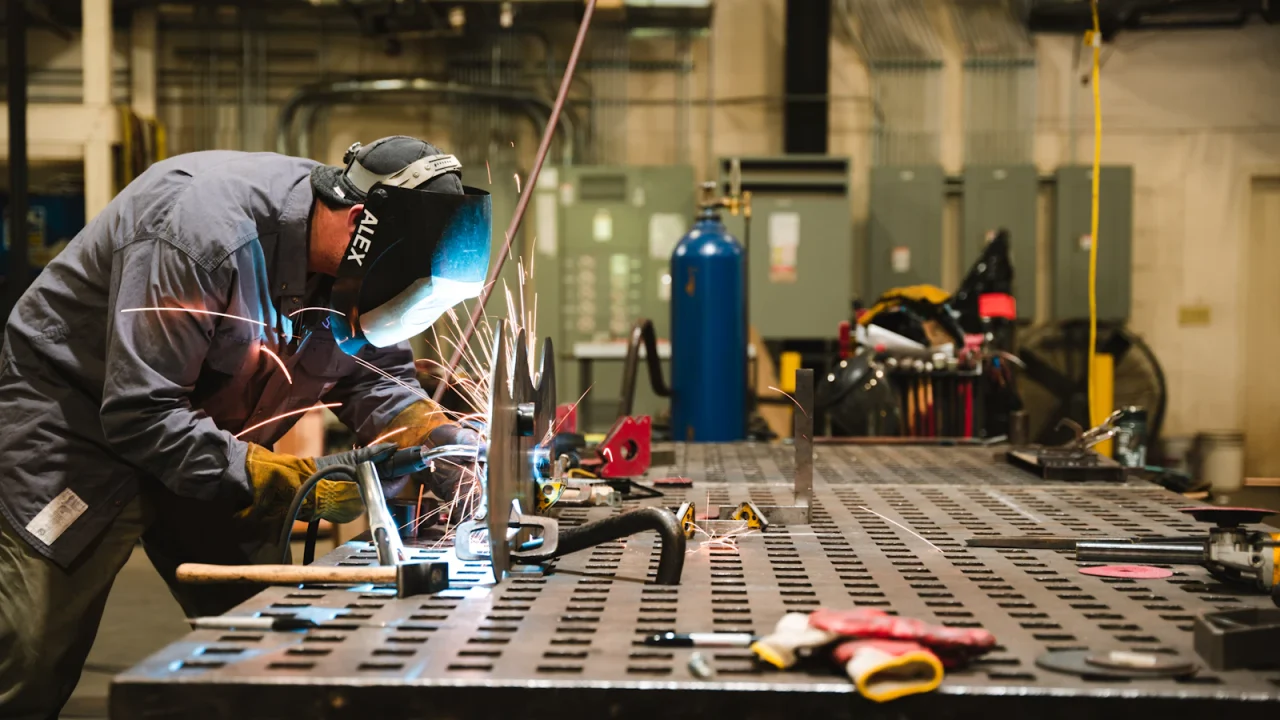
The top is what you are paying for. A welding table needs a flat, bare-steel top thick enough to stay flat under the heat and clamping your projects put into it. If the top flexes or warps, everything you assemble on it comes out slightly out of square.
On this page
After the top, the question is space. A folding table suits occasional light work in a shared garage. A fixed table with a thick or fixture-hole top suits regular fabrication, if you can leave it standing.
Welding table types compared
| Type | Best for | Key feature | Trade-off | Check price |
|---|---|---|---|---|
| Folding portable table | Small spaces and occasional light work | Folds flat, often with adjustable height and a tilting top | Thin top that flexes, and a lower load rating | See on Amazon (opens Amazon in a new tab) |
| Fixed solid-top table | General fabrication and repair | Thick plate top that acts as a heat sink | Heavy, with clamping only at the edges | See on Amazon (opens Amazon in a new tab) |
| Fixture table with hole grid | Square, repeatable assemblies | Holes across the top take clamps, stops and squares | Costs more, and tooling must match the hole size | See on Amazon (opens Amazon in a new tab) |
| Slatted-top table | Clamping long parts and plasma cutting | Gaps let clamps reach in and sparks fall through | Small parts drop through the gaps | See on Amazon (opens Amazon in a new tab) |
| Weld-it-yourself table kit | Welders who want a fixture top and can assemble it | Pre-cut steel parts that slot together for welding | Flatness depends on your assembly and welding | See on Amazon (opens Amazon in a new tab) |
Top thickness and flatness
A thicker top resists warping and acts as a heat sink that pulls heat away from the work. A thin top is lighter, but it flexes under load and can distort if you weld directly on it. Compare the thickness stated on listings. Folding tables generally use thin sheet and fixed tables use plate, and around 1/4 inch is a common minimum for a general hobby table.
Flatness is the other figure to look for, and makers of fixture tables usually state a tolerance. Check a new top with a straightedge when it arrives.
The top has to be bare steel, because it carries welding current and takes direct heat. Paint and powder coat insulate and burn. Never weld on a galvanized top. AWS identifies zinc fume from galvanized steel as the most common cause of metal fume fever, which welding safety basics covers.
Solid, slatted and fixture tops
Solid tops give the most support and the best heat sink. Clamps only reach in from the edges, so look for an overhang.
Slatted tops leave gaps between steel bars. A clamp can grip anywhere along a slat, and cutting sparks and debris fall through.
Fixture tops have holes on a regular grid that accept clamps, stops and squares, so you can hold parts square anywhere on the surface. Two hole sizes are common on hobby tables: 16 mm and 5/8 inch. They are close in size but not the same, so buy tooling made for your holes. Check the hole spacing on the listing, and budget for clamps. The welding gear hub lists clamps and magnets.
Size, height, load rating and casters
- Size: pick a top that fits your usual projects and still leaves room to walk around it and keep combustibles clear. The home welding area guide covers clearances.
- Height: fixed tables come at one working height. Adjustable legs let you set the top for standing or seated work.
- Load rating: follow the maker’s stated rating and stay within it. Check whether it assumes an evenly spread load, and count the work, clamps, a vise and anything on a lower shelf.
- Casters: wheels make a table easier to move and less steady. Look for locking casters, and check the rating with casters fitted, which can be lower.
Keep the welder beside the table on a welding cart, not on the top.
Small spaces
Folding portable welding table
Why consider it
- Folds flat for storage and carries to the job
- Many have adjustable height and a tilting top
- Slots in the top let clamps grip away from the edges
Best for: Occasional light welding where the table has to store flat
Check price on Amazon (opens Amazon in a new tab)
Type-level recommendation. Compare current models, specifications and prices on Amazon. We may earn a commission.
Precise assembly
Fixture welding table with hole grid
Why consider it
- Grid of holes holds clamps, stops and squares anywhere on the top
- Sold in 16 mm and 5/8 inch hole systems with matching tooling
- Makers usually state a flatness tolerance you can compare
Best for: Fabricators who build square frames and repeat parts
Check price on Amazon (opens Amazon in a new tab)
Type-level recommendation. Compare current models, specifications and prices on Amazon. We may earn a commission.
Buying or building your own
Building a table lets you choose the exact size and top thickness, and the table build guide covers the steps. Two cautions apply: a home-built table has no engineered load rating, and you need a flat surface to build a flat table. If you want fixture holes, buying is simpler. If you have not welded yet, start with smaller beginner projects.
Common buying mistakes
- Buying by tabletop area alone. A large, thin top is less useful than a smaller, thicker one.
- Mixing hole systems. Tooling for 16 mm holes and tooling for 5/8 inch holes are not interchangeable.
- Overloading a folding table. Its rating is for light work, not a heavy vise or large assemblies.
- Laying steel sheet on a wooden bench. Heat conducts through the sheet and sparks collect underneath.
Care, inspection and when to replace
Scrape spatter off the top after each session and keep fixture holes clear. A light wipe of oil slows rust on bare steel, but clean it off before you weld, because oil burns. Check bolts, leg locks and caster locks, which loosen with use. Replace a folding table whose top has warped or whose legs or locks are bent.
Frequently asked questions
How thick should a welding table top be?
Can I do real welding on a folding table?
Should I choose 16 mm or 5/8 inch fixture holes?
Do I need to ground a welding table?
Sources and further reading
Related gear on Amazon
Shortcuts to current Amazon listings for the items mentioned in this guide. These are affiliate links.
Tools that help with this decision
- Welder Match Quiz — Ten quick questions that match you to a type of welder.
- Amperage Calculator — Estimate the amperage range for your material and process.
- Power Compatibility Checker — Verify voltage, breaker, and outlet before buying.
- Setup Generator — Build a safety-first setup checklist.